A major shift is underway in Financial Services as enterprises move from platform modernization to production AI at scale.
Across the sector, the challenge has moved beyond investment and experimentation. Most institutions have modernized core parts of the data estate, expanded access to advanced models, and validated early AI use cases. Now, the real question is how those investments translate into measurable change across the business.
That is where friction remains. In Financial Services, AI shapes decisions with direct financial, operational, and regulatory consequences across credit, fraud, compliance, customer service, or portfolio workflows. To deliver impact at scale, FSI firms need more than technical AI capability. They need an operating model that connects data, models, governance, and execution in a way organizations can scale with control.
Why Platform Modernization Fails to Deliver Enterprise Value
Many financial organizations modernized their platforms expecting scale to follow, only to find that many of the same limitations still exist, now embedded in a more complex environment.
What we see here at Indicium AI is that the issue is rarely a single technical gap. It is usually a set of structural conditions that make production AI harder to operationalize than the original modernization effort suggested.
In practice, five issues tend to surface:
1. Fragmented architectures: Data, models, and workflows operate across disconnected systems, which increases pipeline fragility and slows deployment.
2. Proliferation without governance: New tools and use cases expand faster than control frameworks. Cost rises, and consistency drops.
3. Chronic data quality issues: Teams spend up to 80% of their time preparing data instead of generating value, introducing operational and regulatory risk.
4. Business and Tech misalignment: Delivery cycles do not match business expectations, preventing use cases from reaching production.
5. Governance under pressure: Regulatory requirements across GDPR, Basel III/IV, and capital markets continue to expand, while many platforms were not designed for this level of oversight.
In regulated environments, these issues carry more weight because they affect how decisions are made, reviewed, and controlled. Taken together, they create a structural barrier to production AI that can result in delayed revenue opportunities, higher operational costs, and increased risk exposure.
Rethinking AI as an Operating Model
AI embeds continuous decision-making into processes such as credit approval, fraud detection, portfolio management, and compliance. These processes require real-time execution, full traceability, and governance across data and model lifecycles.
This changes the role of the platform. AI operates across the architecture, from ingestion and transformation to orchestration, governance, and application. Governance becomes part of system design, and AI drives execution across core business domains such as risk, credit, marketing, and treasury.
Modernization stalls when platforms remain focused on isolated use cases. It delivers value at scale only when execution becomes repeatable and governed.
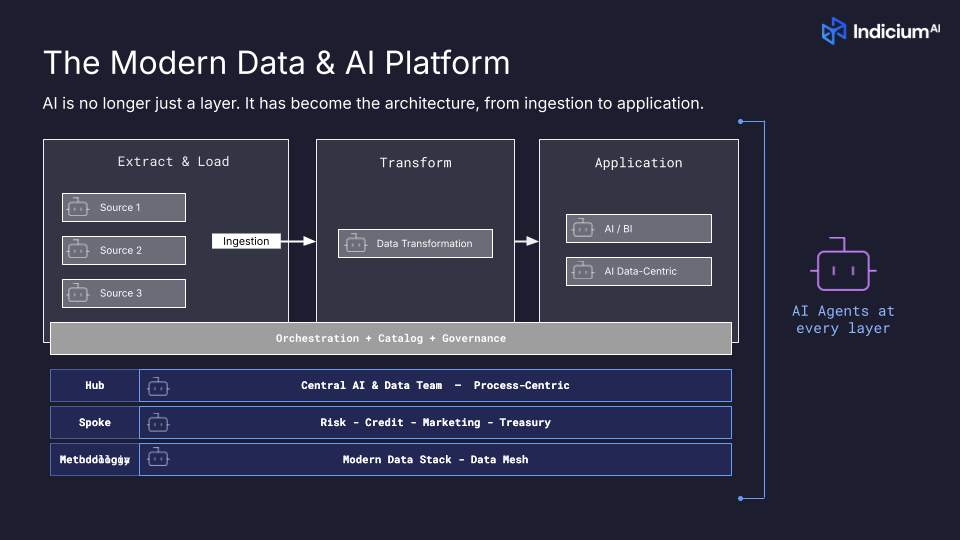
The AI Operating Model for Financial Services
Indicium AI delivers measurable AI impact in Financial Services across three areas of action: the platform foundation, the data layer, and inside business workflows. Together, they shape how institutions generate value, improve efficiency, and maintain control.
1. System and Platform Improvements
This is the foundation that enables AI to operate at scale. It gives organizations a more reliable way to modernize platforms, strengthen governance, protect sensitive data, and accelerate migration. Platforms such as Databricks provide that foundation by unifying data, analytics, and AI under a single governance layer. This ensures more consistent execution, stronger oversight, and a platform that supports AI across the enterprise.
2. AI Data-Centric
This area focuses on building intelligence within the data platform. When data quality, structure, and control improve, AI can support higher-value use cases such as credit scoring, fraud detection, churn prediction, and portfolio optimization with more accuracy and reliability. The value comes from stronger model performance, better compliance, and a data foundation the business can trust.
3. AI Process-Centric
This area focuses on where AI creates the most visible business impact: inside workflows. AI can support decisions and actions across onboarding, customer service, compliance, and back-office operations. Advances in large language models, particularly through partners such as Anthropic, expand the ability to process unstructured data and support complex tasks with defined controls. The result is faster decision cycles, less manual effort, and more consistent execution.
Together, these three areas help institutions move from isolated AI use cases to governed execution at enterprise scale.
From Models to Execution: Where AI Creates Real Value
AI creates measurable value in Financial Services when it operates inside workflows, where Process-Centric AI drives execution.
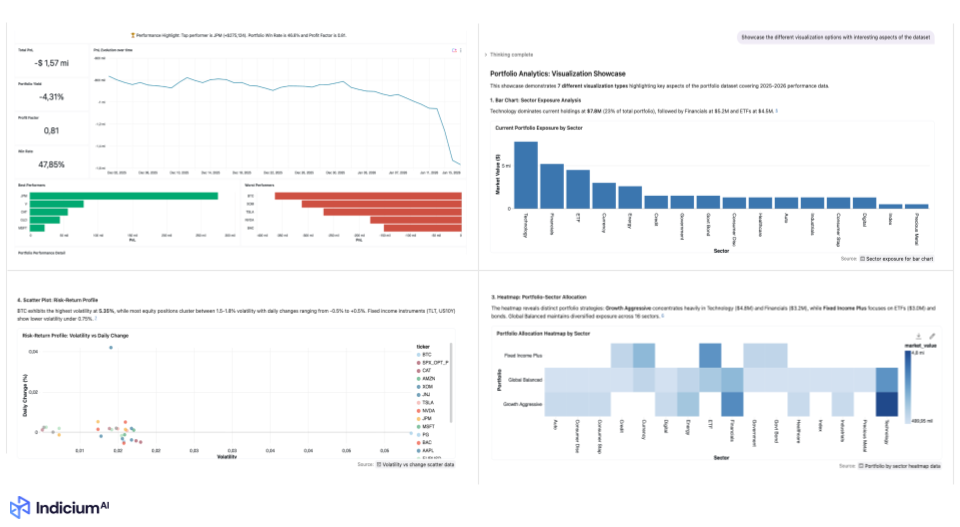
In some cases, that starts with AI / BI, such as portfolio intelligence. When firms can unify exposure, performance, and risk into a more continuous view, teams spend less time assembling information and more time acting on it.
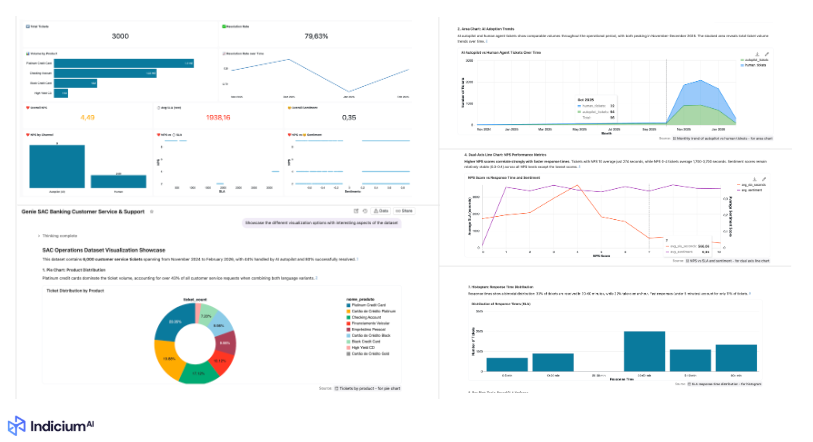
A similar dynamic appears in Customer Service Centers. When teams have a more continuous view of service activity and operational performance, they can respond faster and reduce the friction that comes from fragmented reporting.
In other cases, the impact comes from models applied to high-value decisions. Credit scoring, fraud detection, and portfolio optimization already show how AI can improve accuracy, speed, and control when it operates on governed data foundations. These use cases sit close to revenue, risk, and compliance, which is why they continue to be some of the most relevant applications of AI in the sector.
This is where Process-Centric AI becomes critical. In credit approval, AI can support document extraction, risk analysis, fraud checks, decision logic, and contract generation across one governed process. This level of execution depends on Data-Centric AI to ensure data quality, consistency, and control, and on a platform foundation that enforces governance across every step. Here, AI starts to influence how work is executed, not just how decisions are informed.
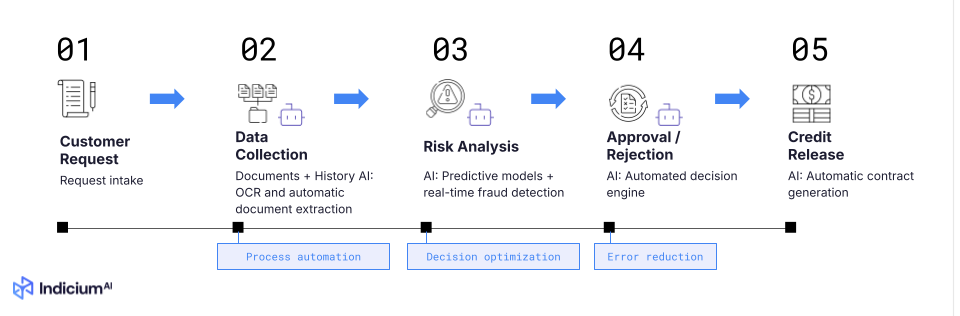
This progression, from visibility to decision support to execution, reflects how AI creates value in Financial Services. The closer AI operates to the workflow, the more directly it improves speed, consistency, and control in decisions with financial and regulatory consequences. Our work with London Stock Exchange Group (LSEG) shows what that looks like in practice.
LSEG: AI Applied to Risk Intelligence
The process for adverse media analysis and Know Your Customer (KYC) at LSEG required a more scalable and efficient approach to content curation as data volume and complexity increased.
We developed a GenAI-driven solution that automates and streamlines content curation. The platform supports the identification, enrichment, and extraction of entity data from raw articles, enabling researchers to focus more on high-value analysis and complex decision-making while creating the foundation for broader AI advancement over time.
This approach improved both speed and operating capacity. Content curation review time decreased by 65%, enabling near real-time updates to World-Check adverse media records and helping clients act on critical information faster. The solution also freed up researcher capacity by 33%, allowing teams to dedicate more time to strategic, high-value work while preserving the accuracy and reliability expected from LSEG Risk Intelligence.
This example highlights how Process-Centric AI improves risk intelligence operations through a more scalable and efficient content curation workflow, built on a governed data foundation and designed to support quality, speed, and future innovation.
Explore more AI success stories in Financial Services.
The Role of AI Agents in Scaling Execution
As organizations scale production AI, agent-based systems play an increasingly important role. These systems coordinate multiple steps within a workflow, interacting with data, tools, and models to execute tasks with defined controls.
At Indicium AI, this approach is embedded into how we deliver projects. Our R&D team has developed a proprietary ecosystem of plugins, skills, and agents designed to support the data platforms we work with. Today, that ecosystem includes 42 skills and 17 agents developed in-house and applied across engagements from day one.
These agents allow teams to structure execution more consistently across use cases such as platform migration, portfolio intelligence, and customer operations. They operate within governed environments, integrate with modern platforms, and leverage models such as Claude, from Anthropic, to perform multi-step tasks with control and repeatability.
The result is a more controlled and scalable delivery model. Instead of rebuilding workflows for each initiative, organizations can execute with a predefined layer of capabilities that improves speed, consistency, and operational control.
What Enterprise AI Execution Requires Next
The next phase of AI in Financial Services will be defined less by access to technology and more by how institutions execute with it. Platforms will continue to improve, models will become more accessible, and delivery cycles will keep accelerating. The harder task is turning those capabilities into consistent execution across the workflows that shape business performance.
As AI becomes embedded in core operations, it directly influences revenue, cost efficiency, and risk exposure. That raises the importance of governance, ownership, and execution discipline. The institutions that create the most value will be the ones that can connect business priorities, platform capabilities, and operational execution in a way that scales across the enterprise.
How Indicium AI Delivers Execution
Indicium AI builds production AI systems for Financial Services firms by combining platform expertise, governance frameworks, and AI-native delivery.
We work across Databricks and Anthropic to help institutions turn modernization into governed execution. That includes modern platform architecture, AI deployment, and delivery models built for regulated environments. This gives Financial Services companies a more structured way to scale AI across workflows where speed, control, and traceability matter most.